AI4Ocean · Digital Twins for Oceans

Digital Twin for Innovation in Oceanic Visualization and Exploration

DIVE develops advanced ocean digital-twin components for causal exploration, what-if analysis and interactive visualization across three European sea basins.

About DIVE

A three-year research project supporting climate-neutral, sustainable and resilient blue-economy pathways through Digital Twins for Oceans.

Project profile

DIVE proposal is responding to the Second Joint Co-funded Call - SBEP2024, "Unified Paths to Climate-Neutral, Sustainable, and Resilient Blue Economy: Engaging Civil Society, Academia, Policy, and Industry". It fits the Priority Area 1 of the call: Digital Twins for Oceans (DTO), considers 3 European sea basins, and aims at contributions to environmental objectives 1. Climate change mitigation, 2. Climate change adaptation, 3. The sustainable use and protection of water and marine resources, it supports EU policy implementation in areas of environment, climate, fisheries.

AcronymDIVE
Contract139 / 25.08.2025
CoordinatorNational University for Science and Technology Politehnica Bucharest (UNSTPB)
Implementation intervalAugust 2025 - August 2028 (3 years)
Budget€250.000 / 1.249.500lei (Romanian National level)
Founded by UEFISCDI through ERANET-SBEP program

Project overview

The project combines multimodal data, artificial intelligence, simulation and visualization to turn observations and model results into actionable intelligence.

Proposed solution

Proposed solution consists in the elaboration of a novel paradigm AI4Ocean. We implement 3 complementary functions to the existing DTO systems and beyond the state of the art: the “what-if” and “causal” exploration DT components and the “ocean visualizer”. Our novelty lays in focusing on physics informed models, performing beyond the classification and prediction tasks, elaborating multi-modal generative models for the ocean dynamic states and the on the discovery of causal relations. We generate actionable intelligence to discover new insights in the observations/modelling results. The proposed approach will facilitate the integration, visualization and scenario prediction from data emerging from biophysical ocean observations, simulation models and remote sensing. This promotes effective decision making in the management of sensitive marine communities and ecosystems in the face of climate change. Coupling observations and numerical coupling thanks to advanced AI methods will bring decisive short term weather information in the Atlantic and Mediterranean basins and allow for accurate decision tools for offshore wind farm operations. For the Black Sea, a novel approach based on high-resolution EO data will fuse the mean SAR Doppler velocities and the in-situ measured data in a scenario for environmental impact assessments, and geo-spatial analysis and statistics. For the Norwegian Sea, the DTO is the first all-in-one solution that can: (i) integrate multi-platform ecological data, (ii) visualize, (iii) make scenario predictions while (iv) making these digital products available to the target groups, such as managers, policymakers, and the public.

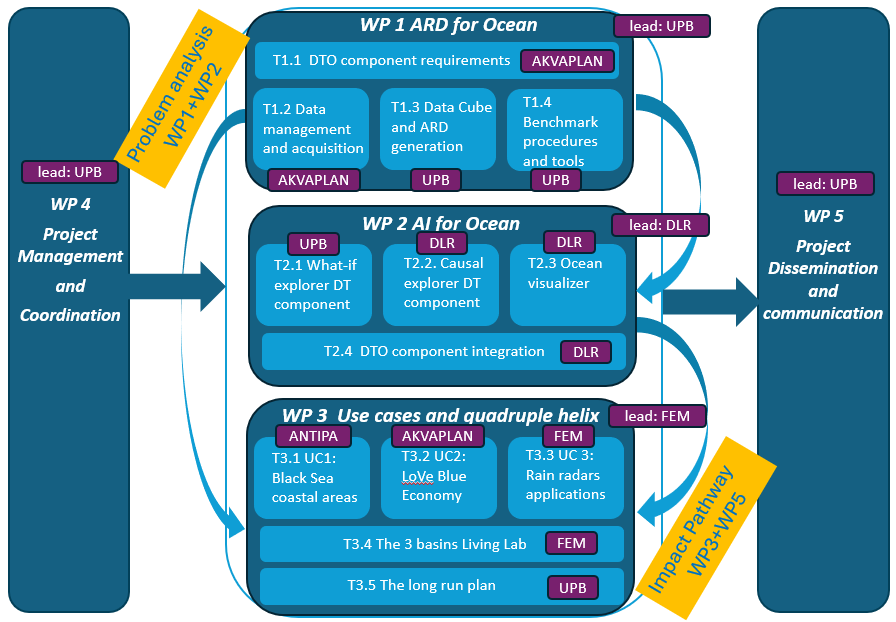
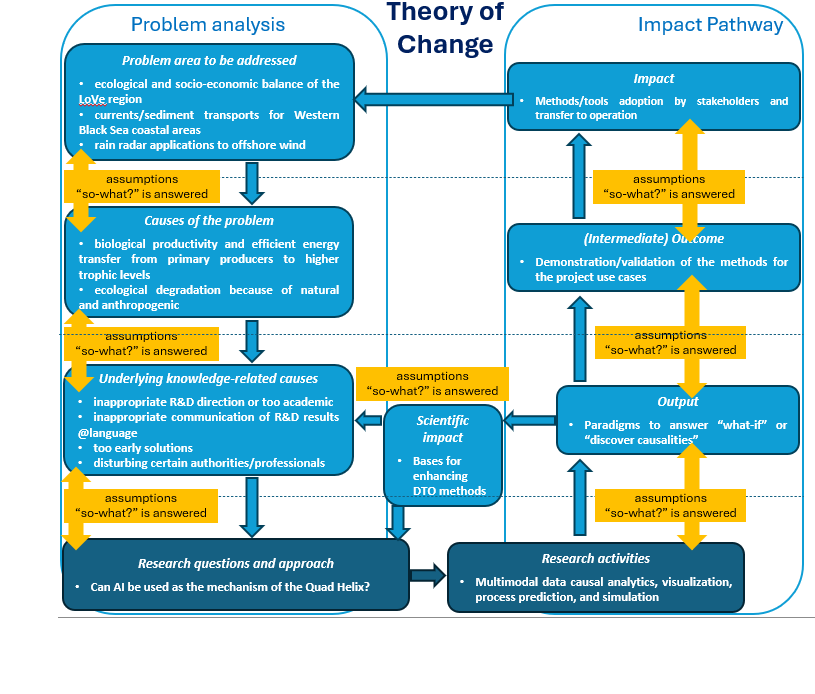
DIVE Theory of Change diagram

Objectives

Project’s main objectives consist of the development of innovative Decision Support Tools (DSTs), fostering the full use of scientific knowledge for effective management and conservation and elaboration of tools for advanced space-based remote sensing observations.

01

Reference ARD

Provide a multimodal, in-situ and remote sensing, reference Analysis Ready Data set

02

What-if explorer

Implement a what-if explorer DTO component, to enhance, complete existing models or create new models, to test hypotheses and give variation of different data features and processes parameters, such to provide flexible and complete solutions in real-life usage by different organizations

03

Causal explorer

Implement a causal explorer DTO component, an analytical tool to discover process causal relations from data and guide decision making to explore, validate cause-effect relation, discover misleading conclusions from incomplete data, providing uncertainty measures

04

Ocean visualizer

Implement an Ocean Visualizer DTO component, a visualization tool to interactively explore and analyze raw and simulated data to ease and guide domain experts in their analysis pipeline

05

Living lab

Establish a joint living lab for 3 European basins, to demonstrate and scale-up the innovations and businesses based on the developed components in real-life scenarios to create sustainable impact via a strong iterative interaction with stakeholders in a quadruple helix model

06

Long-term impact

Elaborate a dissemination, exploitation, communication plan, propose a long-term vision and expand the quadruple helix model, assess specific measures to be implemented to secure the product development process and integration with European Digital Twins systems for ocean

Work packages & planning

The technical work is organized around ocean-ready data, AI components, use cases, management and dissemination.

DIVE work-package structure DIVE work-package structure

Deliverables

WP1 — ARD for Ocean

D1.1 List of DTO component requirements (M6)
D1.2 DMP, DCAT, source code (data acquisition pipeline, and other source code developed by project members) (M12, M30)
D1.3.1 Database Design Report (M12) D1.3.2 Database prototype (M12, M24)
D1.4 Benchmark tools with dedicated functionalities (M12)

WP2 — AI for Ocean

D2.1.1 Report on the study of the what-if platform architecture (M24)
D2.1.2 What-if explorer interface (M30)
D2.2.1 DIVE Design Report (M17)
D2.2.2 DIVE System Integration Report (M24)
D2.3.1 DIVE System Prototype (v1- M24, v2 – M30)
D2.4 DIVE WEB API platform Prototype (M34)

WP3 — Use cases and quadruple helix

D3.1.1 Reports on the effects of climate change on the Black Sea local marine hydrodynamics (M12, M36)
D3.1.2 Maps of the currents and sediment transports on the coastal areas of the Black Sea (M24, M36)
D3.2.1 Quality-controlled, standardized 4D Environmental and biological datasets (M12, M24, M36)
D3.2.2 Simulation engine (a coupled bio-physical simulation model) to predict ecological interactions from the data (M24, M36)
D3.2.3 Simulated present states and future ecological scenarios and their socioeconomic ties (M36)
D3.3.1 Structured database for the DTO, applied to rain radar applications toward weather forecast (M12)
D3.3.2 Report on studied weather forecast correction approaches and related machine learning alg. (M36)
D3.3.3 Rain radar application algorithms developed (M36)
D3.4.1 Methodologies and best practice guidelines for developing living lab environments for Digital Twins for the oceans (M24)
D3.4.2 Report/notes on stakeholder perspectives on potential future scenarios in the sectors evolution and perception & recommendations for DTO development. Data collected on their observed and experienced obstacles with the development of DTOs. Potential pathways to overcome these challenges (M36)

WP4 — Project management and coordination

D4.1 Project management plan (M12, M24, M36)
D4.2 Quality assessment report (M12, M24, M36)
D4.3 Data Management plan (M12, M24, M36)

WP5 — Project dissemination and communication

D5.1 Reports on dissemination material (M12, M24, M36)
D5.2 Reports on public outreach (M24, M36)
D5.3 Reports on community consolidation (M36)

Reports

Stage 1 covers the period 25 August–31 December 2025 and includes activities from WP1 and WP4 coordinated by Politehnica Bucharest.

Stage 1

Interval: 25.08–31.12.2025

Budget for Romanian partners: €140,000

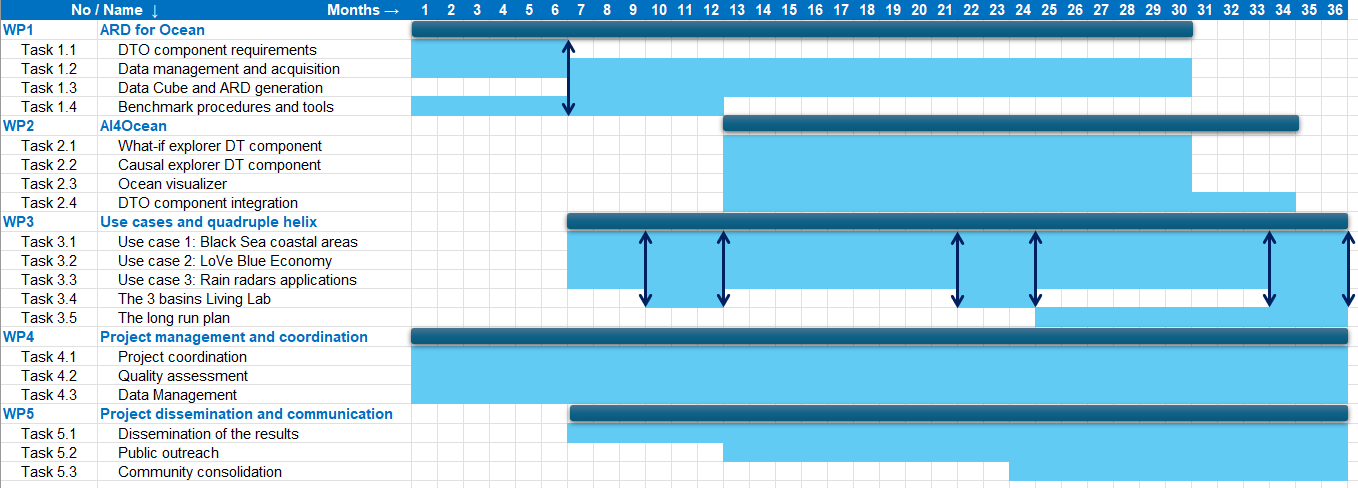
The interval of the first report is marked on the above Gantt chart, for a clearer overview of the project’s activities contained in Stage 1. It can be noted that the associated interval contains activities from Work Packages 1 and 4, both being coordinated by Politehnica Bucharest. It can be noted that 3 of the 4 tasks from WP1 started along with the project. The same starting point is valid for all the activities of WP4. One deliverable was generated for each task from WP1 contained in the reporting period. A separate deliverable was created for the tasks of WP4. Those deliverables are available below.

Events

A selection of project meetings, dissemination events and European Digital Ocean community activities.

Digital Ocean Forum

Digital Ocean Forum #4

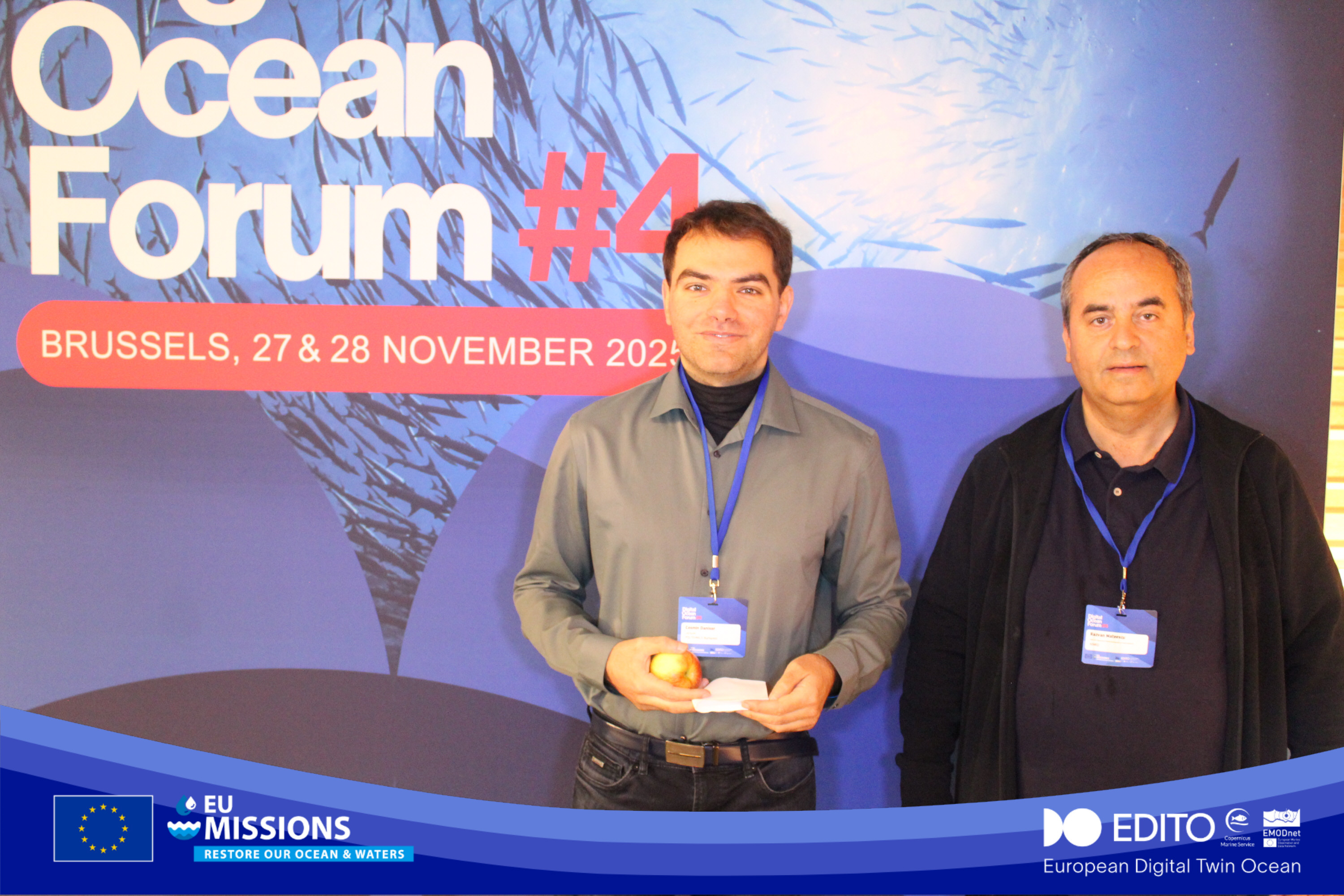
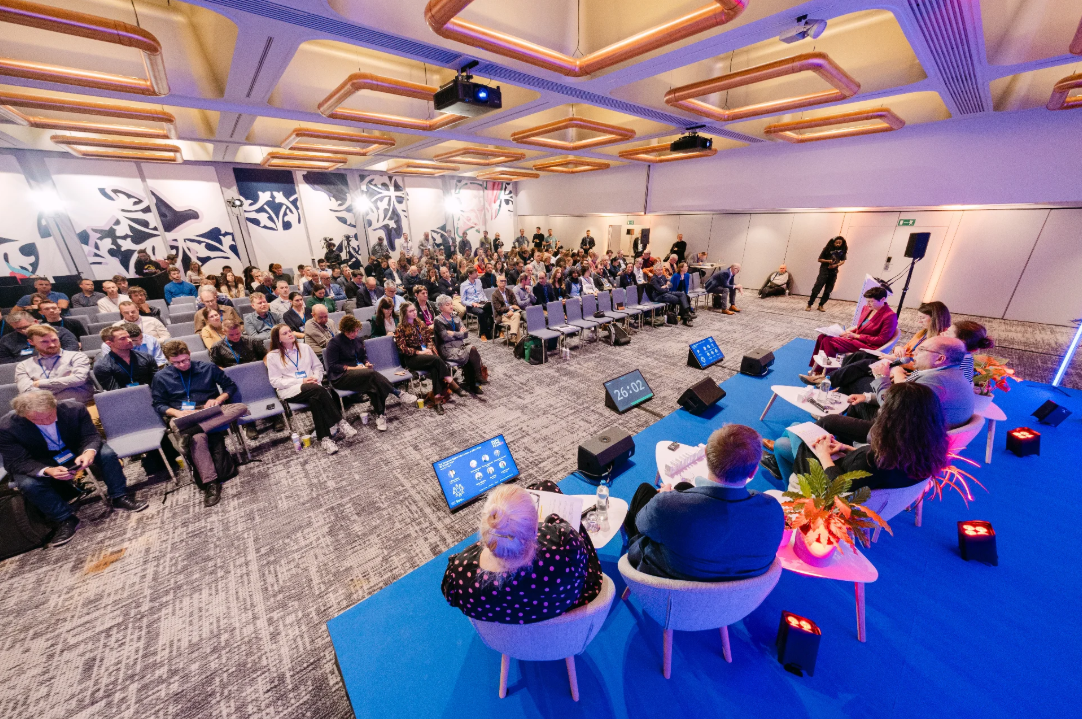
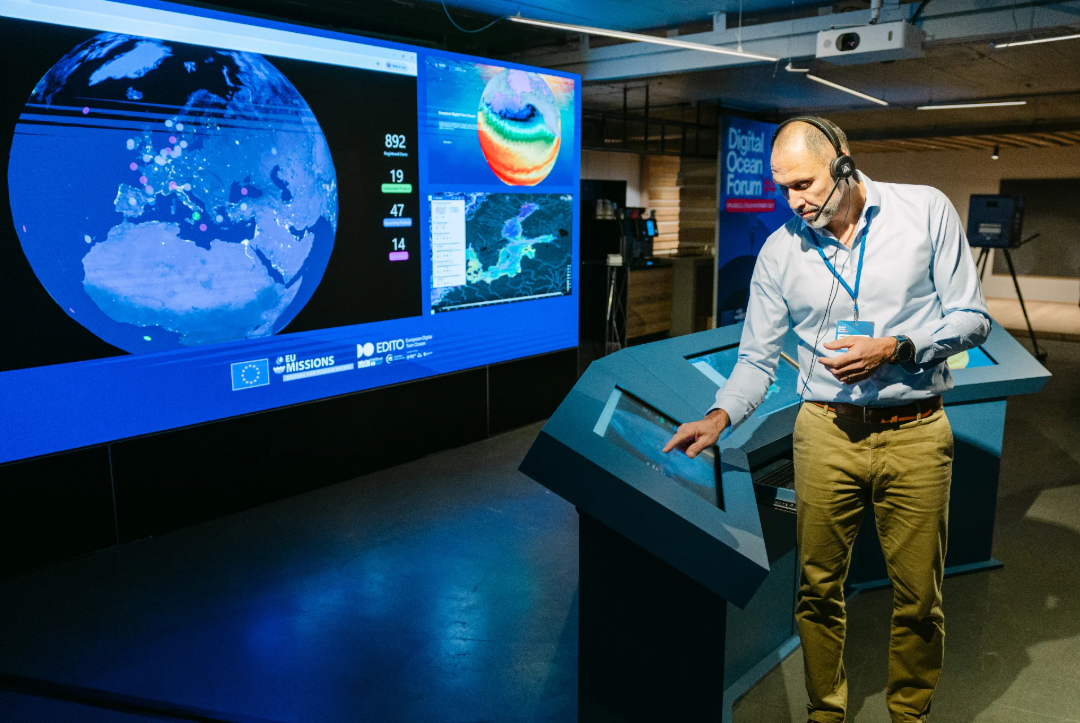
Members from both Romanian Institutions of the Consortium participated to the Digital Ocean Forum #4, organized in Brussels between 27-28 November 2025. This event was dedicated to the consolidation of the EU Digital Ocean Platform within the EDITO project, the presentations and discussions being focused on the most recent evolutions and on perspectives for future developments. The event was attended by a vast number of experts involved on research projects with European funding. The first day of the Forum debuted with the opening of the event, followed by a practical demonstration of the platform’s functionality. The follow-up technical presentations focused on the implementation of the Digital Ocean Models through EDITO2 platform and on the imminent future development directions. The schedule continued with the discussion of multiple case studies from Horizon projects in which the EDITO platform was exploited. The members of DIVE’s Consortium which attended the Forum covered the participation to all the interactive sessions, dedicated to the data, models and applications. The second day of the Forum debuted with sessions dedicated for the interconnection of EDITO’s platform users and continued with interactive sessions, which continued the topics from the previous day. Over the two days of the Forum, we met new persons with whom we consolidated the professional relationship. Among them, we identified institutions’ representatives which could become user partners within DIVE project.

DOF2025_agenda

DIVE consortium meeting

First physical meeting

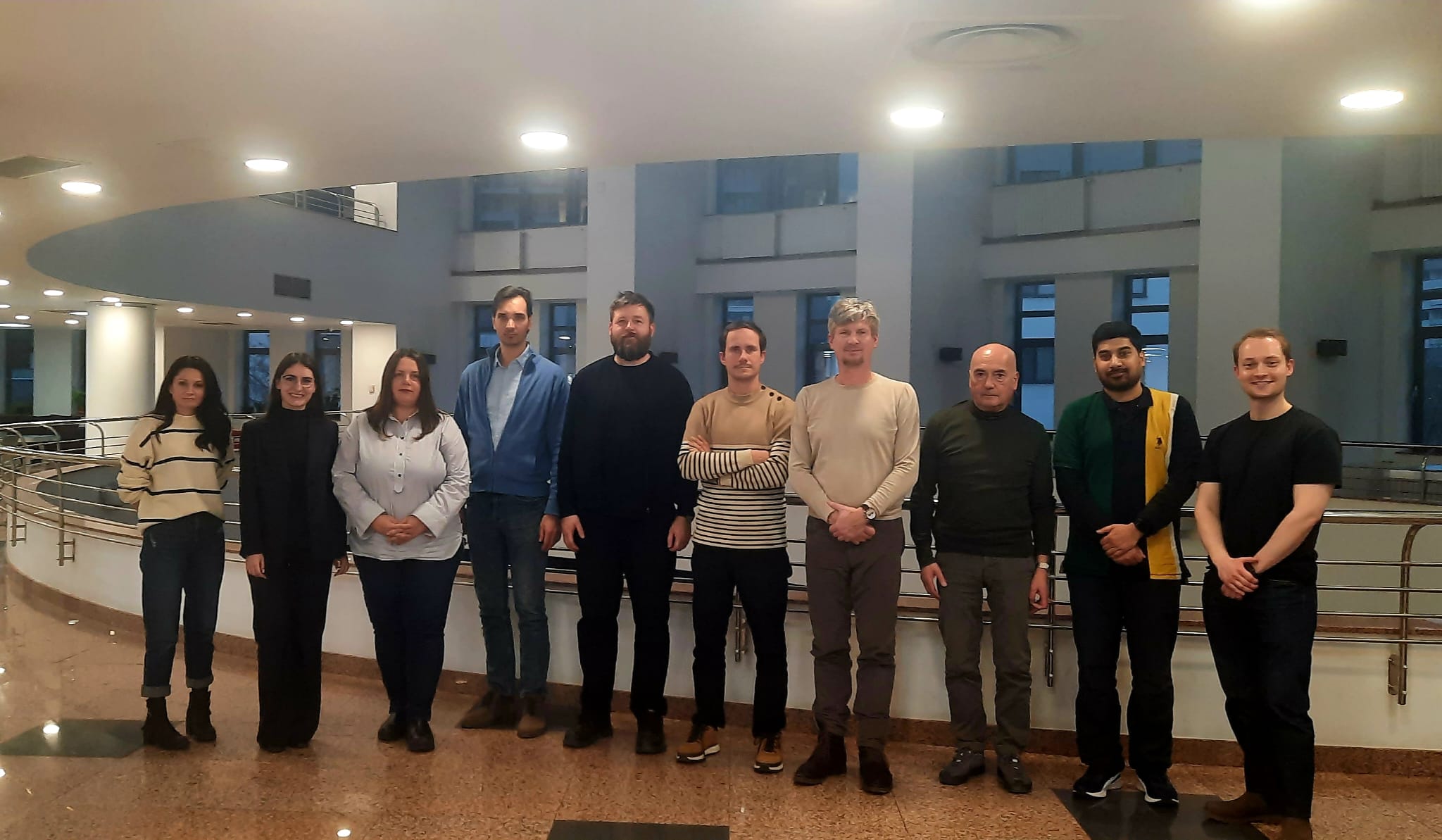
The first physical meeting of the DIVE Consortium was organized by UNSTPB at the Central Library of Politehnica Bucharest, on February 10th 2026. Members from all the Consortium’s partners were present. The agenda of the meeting focused on the project’s general and immediate objectives recap and on technical discussions about the ongoing Work Packages.

agenda_DIVE_1st_meeting

Full Sail Ahead symposium

Full Sail Ahead

This event, organized by SBEP, represented the kick-off meeting for the initiation of the projects financed through the 2024 Joint Transnational Co-Funded Call of Sustainable Blue Economy Partnership. At least one representative of each selected project was present at the event. From our consortium, 3 members were present, from UNSTPB, INCDM and FEM. The agenda included a Posters Session, which represented a good opportunity to disseminate DIVE’s project objectives, proposed architectures and use cases.

agenda_sbep_full_sail
poster_sbep_full_sail

Dissemination

DIVE communicates its scientific approach and project results to research, policy, industry and civil-society communities.

Conference paper — IGARSS 2026

Title: “DIVE: Digital Twin for Innovation in Oceanic Visualization and Exploration”

in which the overview of the project is described, for scientific community outreach.

Conference: 9–14 August 2026, Washington, D.C.

The paper presents an overview of the DIVE project for scientific-community outreach.

Technical programme

Contact

Contact the project coordination and Romanian partner representatives.